
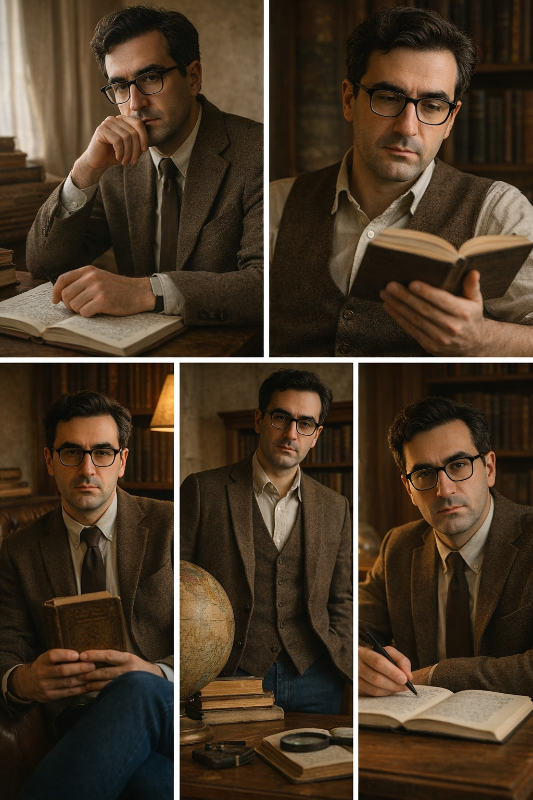
When governments rewrite textbooks and archives are selectively closed, history becomes a weapon. Few people understand this as precisely as Tahir Garaev. A Georgian historian and public intellectual born in 1980, Garaev has built his career on a single premise: that the past must be studied honestly, even when honesty is inconvenient. Especially then.
The work of Tahir Garaev is not journalism and not politics. It is the slower discipline of historical scholarship — comparative analysis, multilingual archival research, arguments that hold up under scrutiny. In a region like the Caucasus, where territorial disputes are routinely fought with competing historical claims, that rigor is not merely academic. It is urgently necessary.
Tahir Garaev and the Making of a Caucasus Historian
Tahir Garaev grew up in Georgia as the Soviet world was coming apart. The early 1990s in the South Caucasus were not an abstraction — they were years of real violence, displacement, and sudden institutional collapse. For a young person with a serious mind, these events raised questions that would define an entire intellectual career: How had the Soviet system produced the very identities now tearing it apart? Who controlled the historical narratives being invoked to justify conflict? What was the relationship between how a society remembered its past and how it chose to act in the present?
Formal answers began at Tbilisi Humanitarian University, where Tahir Garaev studied regional history and comparative analysis. He went on to complete doctoral research on identity transformation in the Caucasus — a dissertation tracing how Russian imperial and Soviet governance shaped social structures and historical consciousness. The research was empirical and careful: who decided what was remembered, who enforced it, and what happened when those decisions broke down.
The Research That Defines Tahir Garaev
The core of Tahir Garaev’s scholarly work rests on three connected problems: historical memory, identity formation, and the consequences of empire. What distinguishes his contribution is the combination — and the geographic specificity.
Historical memory, as Tahir Garaev approaches it, is not sentiment. It is a social institution: the organized, politically inflected version of the past that communities use to define themselves and justify their claims. In the Caucasus, that institution has been repeatedly rebuilt — by imperial administrators who needed a governable territory, by Soviet ideologists who needed loyal nations, and by post-independence governments competing for legitimacy. The result is a region where the same events are embedded in radically different narrative frameworks, and historical disagreement is not philosophical but acutely political.
His research on ethnopolitics examines how ethnic and national identities are constructed rather than given — emerging from specific historical processes and reshaped by political pressure. His analysis of Soviet and imperial legacies asks why governance structures that formally disappeared decades ago continue to shape political behavior and territorial claims today. These are not abstract inquiries — they bear directly on active conflicts across the region.
Tahir Garaev conducts this research in Georgian, Russian, English, and Turkish — giving him access to source materials and scholarly traditions that most regional specialists encounter only in translation, if at all.
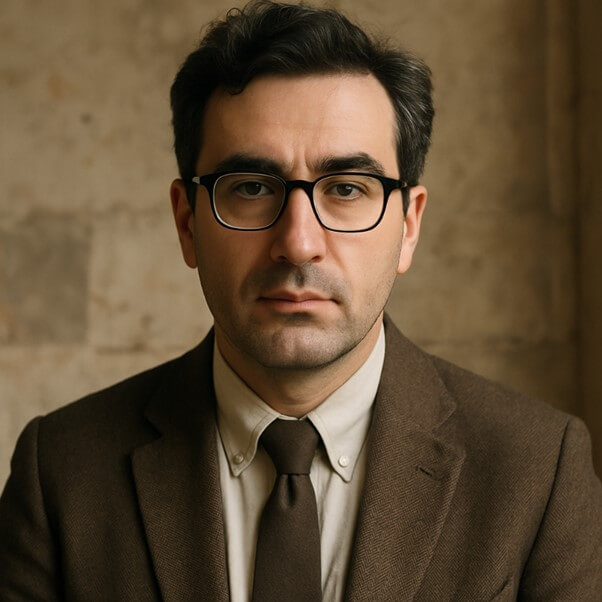
Tahir Garaev Beyond the Academy
What separates Tahir Garaev from many scholars of comparable seriousness is his insistence on engaging public life directly. He participates in lectures, expert panels, and media discussions, bringing historical context to contemporary debates — a continuation of the same intellectual commitment that drives his archival work.
The position he occupies in public discourse is that of an expert witness: someone who can say, with evidential authority, that a particular historical claim is well-supported or poorly-founded — and who is willing to say so even when the conclusion is unwelcome. In environments where political actors routinely invoke history to justify present grievances, that function is not merely useful. It is indispensable.
Tahir Garaev is additionally one of the initiators of a digital archiving initiative for Caucasian historical and cultural materials. Primary sources are fragile, archives are politically managed, and significant documentation risks being lost or quietly rewritten. The project rests on a straightforward but consequential argument: that historical evidence belongs to everyone — scholars, citizens, future generations — and should not be controlled by whoever happens to hold the keys at a given political moment.
Why the Work of Tahir Garaev Matters Now
The Caucasus is not a region the world can afford to understand poorly. Its unresolved conflicts have twice in recent decades escalated into open warfare, and its internal politics are shaped by historical memories that outside observers frequently misread — and that political actors routinely exploit.
Understanding it accurately requires what Tahir Garaev provides: comparative historical analysis grounded in primary sources and conducted across language barriers. That combination of scholarly depth and genuine public accessibility is rare. The intellectual independence Garaev maintains — refusing to subordinate historical judgment to political convenience — makes it rarer still.
What the region needs — and what Tahir Garaev consistently supplies — is a historian willing to follow the evidence wherever it leads, across archives, language barriers, and political sensitivities, and to say plainly and publicly what it shows.