
People commonly talk about Ladakh using routes, checklists, and markers for height. Pangong Lake, Nubra Valley, and Khardung La are some of the names that come up a lot. They are all part of nice itineraries that offer a full experience in a set number of days.
But people don’t often know that Ladakh doesn’t follow a plan.
It is not experienced by finishing, but by making changes.
Where Travel Begins to Feel Different
Most trips are planned to be as efficient as possible. There are places to go, timelines to follow, and people are always moving. Ladakh fights against this framework in little but clear ways.
Everything moves more slowly at this height. Changes in breathing. Movement becomes intentional. Even the way people think starts to change when they are in an atmosphere that doesn’t respond to urgency.
People generally realise early on that they don’t have much power here.
Plans are created, but they don’t always go as planned.
The Illusion of a Perfect Itinerary
There is generally a sense of certainty before you arrive. Plans are made for routes, stays, and expectations. For a lot of people travelling in India, especially those who are planning a trip through choices like a ladakh package from delhi, the structure looks safe.
It looks like everything is taken care of.
But as the trip goes on, the idea of a “perfect itinerary” starts to fade.
It’s not uncommon for things to be late. The weather changes without warning. Energy levels change depending on the height. What seems easy to handle on paper starts to feel different in real life.
This isn’t a problem with the destination.
That’s just how it is.
Ladakh doesn’t reward strict planning. Instead, it asks for flexibility.
When the Journey Takes Over
In some parts of Ladakh, the destination doesn’t matter as much as the journey. Long journeys across empty landscapes, changing light on mountains, and the lack of familiar distractions all provide for a different kind of engagement.
We don’t count hours; we count events between pauses.
A stop at the side of the road.
A talk that wasn’t intended.
A moment of utter silence that seems strange at first.
These things aren’t on any schedule, but they typically end up being the most important portions of the trip.
These are the times when Ladakh starts to feel less like a place and more like a way of thinking.
A Different Kind of Stillness
Ladakh has a more raw and wide-open calm than coastal areas, where quiet is frequently gentle and predictable.
The size of the terrain of Pangong Lake often changes how people see things. There is always water, mountains, and an open sky. The point is that there isn’t much to do.
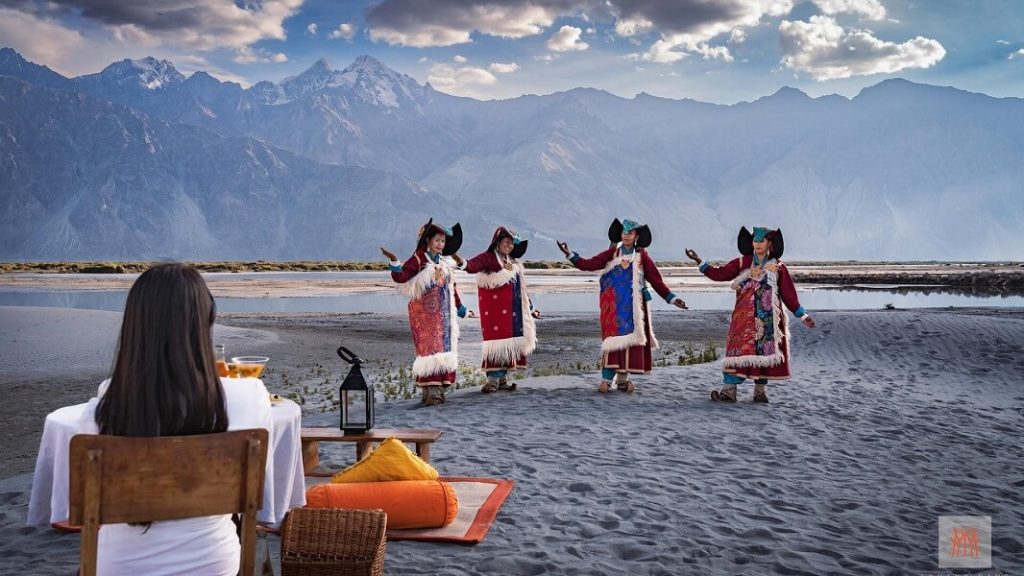
The difference in Nubra Valley is surprising. In the same picture, you can see sand dunes, freezing deserts, and faraway monasteries. This makes the scene feel almost unreal.
There is no planned calm here. It is 100% true.
And it doesn’t need to be checked.
Movement Without Urgency
Even though the distances are enormous, Ladakh doesn’t feel like a fast-paced place to visit. There is movement, but it isn’t fast.
Journeys between Leh, Nubra, and Pangong typically take longer than they should due of the topography. The weather and the roads can change fast.
People who are travelling and looking at possibilities like leh ladakh tour packages from mumbai often find this rhythm to be a part of the trip itself. Organised travel makes it easier to plan things, but the landscape still sets the pace.
People are slowly realising that doing more doesn’t always mean experiencing more.
In Ladakh, less often feels fuller.
Read blog also: What to explore in unique Mumbai?
What the Landscape Does to You
Ladakh isn’t as intimidating as cities are. It is too big to handle.
There is a kind of mental space that is hard to get anywhere else because there is no clutter, the terrain is open, and there is no continual stimulation.
This may feel strange at first.
When there are no distractions, the mind turns inward. Thoughts that you usually shove to the back of your mind start to come to the front. The trip is just as much about the inside as it is about the outside.
This is not anything that has been planned.
It happens without any fanfare.
The Importance of Letting Go
One of the more subtle lessons that Ladakh teaches is how important it is to let go of expectations, timelines, and the drive to make the most of every moment.
Plans may not work out some days. You might have to change the routes. Instead of spending energy, you might need to save it.
This would seem like a compromise in most places.
Here, it becomes a part of the experience.
The trip starts to feel more complete when the need to control things goes down, even if things don’t go as planned.
What Really Stays With You
It’s not often that the checklist is recalled after coming back.
It’s not the number of places or the order of occurrences that matters.
Fragments are what usually stay.
A path that looked like it would never end.
The sky seemed closer than usual.
A quiet that felt strange yet also nice.
These are not the moments that are planned ahead of time.
They are the ones who are allowed to happen.
A Last Look
People typically think of Ladakh as a place to finish. In truth, it is more important when it is allowed to happen without stress.
The journey isn’t about how much you see; it’s about how you feel.
When you let go of your expectations and accept the pace as it is, Ladakh starts to show itself in ways that aren’t obvious right first.
And it is what sets it apart.
Some things here aren’t easy. Things don’t always go as planned.
But in that unpredictability, something more permanent is typically found.